Showing posts with label Pennsylvania. Show all posts

Friday, January 1, 2016

Spotlight: Pennsylvania - Valley Forge

Spotlight: On December 19, 1977, the Continental Army marched to Valley Forge to spend the winter. The site was chosen so that the army could keep an eye on the British (who were spending the winter in Philadelphia), and protect the supply depot in Reading. Over the next six months, the approximately 12,000 soldiers, who thus far had worked as independent divisions from the various states, worked together to survive the harsh winter conditions. Only about one in three soldiers had shoes, and more than 2,000 soldiers died that winter, despite the fact that they didn't fight a single battle here. Instead of the British, their enemies here were hunger, disease, and the weather. Working together, and drilling together under the supervision of Baron Friedrich von Steuben of Prussia, helped the individual groups form a cohesive army under the command of General George Washington.
Baron Friedrich von Steuben
     The camp included about 500 women and children, including Martha Washington, who served as laundresses washing and mending uniforms, as well as providing emotional support to the homesick soldiers. Women received half the rations and pay as soldiers, as well as half pensions following the war.
     Valley Forge State Park earned national park status in 1976 as part of the U.S.'s bicentennial celebration. It contains 3,500 acres of land with miles of hiking, biking, and horse trails, restored buildings, museums, monuments, and recreational facilities.

Location: Valley Forge National Historical Park is located at 1400 N Outer Line Drive; King of Prussia, PA about 23 1/2 miles northwest of Philadelphia. The easiest way to reach the National Park from Philadelphia is (appropriately) via Interstate 76.

Cost: free; tours cost extra

Time: The park is open from 7:00 am - dark. The Visitor Center is open from 9 am-5 pm daily, and stays open until 6:00 pm from mid-June through mid-August. Other buildings have their own schedule: Washington's Headquarters, the Train Station, Washington Memorial Chapel, Chapel Cabin Shop, and Varnum's Quarters. You should plan on staying between 2-4 hours.

Description: There are various methods of exploring Valley Forge National Historical Park. Tour options include: the Trolley Tour, the Bicycle Tour, a Ranger-led Walking Tour, Private Tours, or a self-guided tour. The self-guided tour follows the 10-mile Encampment Tour Route and takes you past most of the scenic views and historical monuments - such as the magnificent National Memorial Arch (dedicated to the officers and soldiers who served there). You can just follow the map, or listen to the 60 minute audio tour.

National Memorial Arch
     One of the most popular activities is the Living History reenactments that take place at the Muhlenberg Brigade Huts from 10 am - 4 pm daily during the summer months, and on weekends during the fall. Reconstructed log cabins similar to those used by the soldiers are found throughout the park.
     The Visitor Center houses an excellent collection of exhibits that show what life was like at Valley Forge during the winter of 1777-78. Don't miss the 18-minute introductory film Valley Forge: A Winter Encampment shown at the park theater. Also, visitors can hear stories about Valley Forge on the Story Telling Benches located near the Visitor Center and at the Train Station.
silver dollar, 2 half dollars, 4 quarters, and 8 bits
Continental Army uniform
     Washington's Headquarters has been restored and refurbished to appear as it did during the winter of 1777-78. Adjacent to Washington's HQ, visitors can visit the restored Valley Forge Train Station that serves the famous Reading Railroad.
Reading Railroad Train Station 
Washington's Headquarters
     The Washington Memorial Chapel and National Patriots Bell Tower carillon sit on a hill just outside the Park. They are part of the legacy of Reverend Dr. W Herbert Burk, who was instrumental in developing the Park. The chapel hosts an active Episcopal congregation as well as many park visitors. The grounds also host the World of Scouting Museum.

     The Park hosts a variety of annual events. These include: Martin Luther King Day of Service, Washington's Birthday Party, Join the Continental Army, The Revolutionary 5-mile Run, National Junior Ranger Day, Memorial Day Observance, March Out of the Continental Army (6/19), July 4 Community Picnic in the Park, National Public Lands Day, Veterans Day Commemoration, March in the Continental Army (12/19). For dates and details, go to http://www.valleyforge.org/things-to-do/national-park/events/

Rating: 4 1/2 stars (out of 5)

Things You Should Know: - The bicycle tour is a five mile, two hour guided tour available for guests 12 years and up for a price of $10. Bicycles may be rented for an additional $15. For additional information, call 610-783-4593. Visitors may also use bicycles to explore the park's 21 miles of bike trails.
- The film is shown every half hour from 9:30-4:00 pm.
- In addition to bike trails, the park has 19.5 miles of marked hiking trails.
- There are 17 miles of horse trails in the parks, but there are restrictions on where the horses may go.
- The Schuleykill River and Valley Creek are popular with local fishermen. Although you may fish, the park has a strict catch-and-release only policy.
- Valley Forge NHP has three picnic areas. The Betzwood Picnic area, on the northern end of the park, has grills available.
- A fun activity for kids is a special program called Secrets and Spies, in which participants are spies, and must thwart a plot to kidnap General Washington. The program is held on Saturdays at 12:30 pm at the Train Station platform.

Nearby: Jenkins Arboretum & Gardens, Medal of Honor Grove, Wharton Escherick Studio, Elmwood Park Zoo, Washington Crossing Historic Park

Friday, December 25, 2015

Spotlight: Pennsylvania - Hershey's Chocolate World & Hersheypark

Spotlight: Hershey, Pennsylvania is sometimes called Chocolatetown, USA - the Sweetest Place on Earth. The town was named after its most famous business, the Hershey Chocolate Factory, and has tried to capitalize on that theme with various tourist attractions including: Hershey's Chocolate World, Hersheypark, Hersheypark Stadium, Hersheypark Arena, and the Hershey Museum.
     Hershey Chocolate World opened in 1973 to replace the Hershey chocolate plant tour which could no longer accommodate all the visitors. Current attractions include the Hershey's Chocolate Tour, Create-Your-Own Candy Bar, Hershey Trolley Works, Hershey's Chocolate Tasting Group Experience, and Hershey's Great Chocolate Factory Mystery in 4D, as well as various gift shops and stores. Additional Visitor Centers have opened up at other locations around the world including: Chicago, Las Vegas, Niagara Falls, Times Square, Dubai, Singapore, and Shanghai.


     Hershey Park opened in 1906 as a leisure park for employees of the Hershey Chocolate Company. Over the years it gradually added rides, including the first steel looping roller coaster on the East Coast. In 1970, the park was expanded and renovated to add new rides, and was renamed Hersheypark. Today, the park contains 110 acres, and hosts 70 rides and attractions including 13 roller coasters and ZOOAMERICA.

Location: Hershey's Chocolate World and Hersheypark are located at 251 Park Blvd., Hershey, PA.

Cost: Tickets to attractions at Hershey's Chocolate World can be bought individually or in various combo packages. Individual tickets for attractions range anywhere from $7.95-$15.95 per adult (13+), with discounts for children.
-  Hersheypark tickets currently cost $18.00 (3+) during the Christmas season.

Time: Hershey's Chocolate World opens at 9:00 am daily; closing times vary depending on month.
           Hersheypark hours vary depending on the season. During the summer, plan on spending a full day or two in Hershey, since there is plenty to do.

Description: The most popular attraction at Hershey Chocolate World is the Hershey's Chocolate Tour - probably because it is the only free attraction available. No tickets are needed, and guests get to watch the transformation of cocoa beans into chocolate bars. Since the factory is no longer open, the ride focuses more on the process used rather than the actual production. As a special bonus, each guest receives a free sample at the end.


     Another popular attraction is the Chocolate Tasting Group Experience. In this experience, visitors learn the proper methods of tasting the various types of chocolates in order to engage all the senses. It was without a doubt the most delicious degree we've earned.

     The attraction I was looking forward to the most was the Create Your Own Candy Bar experience. It allowed us to not only choose the ingredients, but also design the wrapper. It was fun, but I wish that they had more than a few options for each phase: type of chocolate, special ingredient, and wrapper design.

     With 13 roller coasters, Hersheypark is one of my favorite amusement parks I've ever visited. In only 5 hours, we rode about 11 awesome coasters (as thrilling or better than most of the ones at Six Flags Magic Mountain and Disneyland) and enjoyed several other attractions. The park is family friendly, with rides geared toward every age group. As each person enters the Park, they can measure themselves to see which category they are in. Rides are then posted with the demographics they serve so that guests don't have to wait in a long line only to find out that they can't go on the ride after all. We thoroughly enjoyed the Park and thought that the price was very reasonable - especially compared to the California parks we are accustomed to.


Rating: Hershey's Chocolate World - 4 stars (out of 5)
              Hersheypark - 5 stars (out of 5)

Things You Should Know: - Despite being located on the same lot, Hershey Chocolate World and Hersheypark are both independently owned and operated.
- Ironically, the Hershey Chocolate Factory is now closed, with most of the production taking place overseas. However, the tourist venues remain in Hershey.
- There are several special themed seasonal events, particularly for Halloween and Christmas.
- You can save $1.50 per ticket by purchasing your tickets online.
- Other special discounts are available, including a Hersheypark/Dutch Wonderland combo pack.
- Hersheypark is open seasonally. It opens on weekends starting in late April; opens daily in June, July, and August; is open on weekends again in September; and open during select weeks/weekends during the holiday season (from Halloween - New Years).
- During the summer, you can buy an all day pass or an evening pass to Hersheypark at a very reasonable rate. Since we were driving in from the other side of the state in the morning, we spent the afternoon at Hershey's Chocolate World, and the evening at the amusement park. This worked out great since most of the visitors to the park were school groups (early June) and began leaving soon after we went in. We had long lines for our first two rides, but were able to whiz through much shorter lines as the evening wore on.
- In addition to typical rides, Hersheypark has an accompanying water park, The Boardwalk, with water slides at no additional cost.
- Parking is $9/vehicle at Hersheypark (veer right). Parking at Hershey Chocolate World (veer left) is free for the first 3 hours, $15 for 3-5 hours, or $30 for an all day pass. There is a tram that can take you from the Hersheypark parking lot to Hershey Chocolate World on days when the park is open.

Nearby: Hershey Gardens, Pennsylvania Farm Show Complex & Expo Center, The National Civil War Museum, Dutch Wonderland

Friday, December 18, 2015

Spotlight: Pennsylvania - Washington Crossing Historic Park

Spotlight: Washington Crossing Historic Park lies along the Delaware River at the site where George Washington and the Continental Army crossed the river to launch a surprise attack on the Hessian troops that were holed up for the winter in the city of Trenton, New Jersey celebrating Christmas. During the campaign of 1776, the Continental Army had suffered defeat after defeat to the better trained and better armed British troops and their Hessian mercenaries. Morale among the troops had reached its lowest point, and it looked as if the American Revolution was doomed to fail. Soldiers were deserting every day, returning home rather than continuing what was looking to be a lost cause. The enlistments of many of those who remained would expire at year's end. General George Washington knew that if they went into winter quarters without a victory to buoy morale, there might not be an army left to command once spring rolled around. Therefore, he gambled the bulk of the army on a desperate plan that could either save the war effort or doom it to failure. The attack was launched on the night of Dec. 25-26, when Washington led 2,400 men across the river at McConkey's Ferry.
     The boats used for the crossing were a motley crew of vessels, including several large Durham boats used to carry pig iron down the Delaware. Before crossing, Washington gave a rousing speech to his men. The loaded boats began crossing the ice-choked river at 6:00 pm, under the cover of darkness. Conditions worsened as the night progressed, with sleet making visibility practically nil. The attack called for a three-pronged effort, with two divisions slated to attack Trenton from the south; but the weather forced the commanders of these divisions to abandon the effort. Washington was persistent, however, and successfully transported his troops to the other side. Although they planned to attack under the cover of darkness, the crossing, which included horses and cannon, took nine hours. The delays meant that they reached Trenton under the rays of the morning sun. Luckily, the Hessian troops were still hungover from their celebrations the night before, and Washington's troops were able to capture the entire garrison without a single casualty. The resounding victory reignited the fervor of the colonies, signaling a turning point in their war for independence.
      Today, a reenactment of Washington's crossing is performed every year on Christmas Day. Visitors can watch history in action as actors dressed in authentic uniforms recreate the historic crossing.

Location: Washington Crossing Historic Park is divided into two sections. The "lower park" is headquartered in the village of Washington Crossing at 1112 River Rd, Washington Crossing, PA 18977 at the intersection of Routes 32 & 532. (If you type the address into Google maps, it appears to be on the New Jersey side of the river, but it isn't.) The "upper park" is located 4 1/2 miles away in Solebury Township.
Delaware River at site of Crossing
Cost: Full dress rehearsal of reenactment: $8/adult, $4/child (5-11); Christmas Day reenactment - free;
- Historic Village tours are $6/person; Thompson-Neely House & Farmstead tours are $6/person; Bowman's Hill Tower - $6/person (click here for more information and discounts)

Time: 30 min. - 3 hours, depending on how much you want to see. Most sites are open from 10 am - 4 pm. The visitor's center is open until 5 pm. Visitors can explore the Historic Village until dusk.

Description: The Visitor's Center was completely renovated in 2012. It contains historic exhibits, an educational program, and a large auditorium for movies, concerts, and speaking engagements. Among the exhibits is an original letter written by George Washington while in the McConkey Ferry Inn. Visitors may also purchase tour tickets here.
Artifacts including original letter written by Washington
     The Village (Lower Park) includes the following buildings: McConkey Ferry Inn (built in 1790 to replace the original inn, of which only the basement and kitchen remain); the Mahlon K. Taylor House (an example of a rich merchant's home from the early 1800's); Taylorsville Houses (several 19th century buildings which include residences and small shops); the Hibbs House (it has served as the home/workshop of several tradesmen including a shoemaker, cooper, wheelwright, and carpenter); the Frye House and Blacksmith shop (living history demonstrations are conducted during special events throughout the year); the Durham Boat Barn (it houses the replica boats used in the annual Delaware crossing reenactments).
McConkey Ferry Inn
Blacksmith Shop
Durham boats
     Boman's Tower (Upper Park) rises 125 feet above the top of Bowman's Hill, offering a 14-mile view on a clear day. The Thompson-Neely House and Farmstead (Upper Park) served as a temporary regimental army hospital during the winter of 1776-77. Future president James Monroe convalesced here after being injured during the First Battle of Trenton. Also located on the grounds is Soldiers' Graves - a memorial cemetery for an unknown number of Revolutionary War soldiers who died during the December 1776 encampment.

Rating: 3 stars (out of 5) - Bear in mind that when we went the Visitor Center was under construction, and we never got to see the Upper Park.

Things You Should Know: - There is also a Washington Crossing State Park on the New Jersey side of the river. This is a separate park which we didn't have time to see.
- A full dress rehearsal of the crossing reenactment is held in mid-December. Along with the reenactment, visitors can participate in special colonial-era activities and demonstrations throughout the historic village. The Christmas Day reenactment will be held from Noon to 3:00. River crossings may be cancelled if conditions are deemed too dangerous for the participants.
- The painting of "Washington Crossing the Delaware" is a full sized digital copy of Emanuel Gottlieb Leutze's original from the Metropolitan Museum of Art.
- Bowman's Tower was built in the 1930's to commemorate what may have been a lookout post for Washington's troops. No such tower existed in Washington's day.
- We drove around for about 45 minutes trying to find the Upper Park, but never did (thanks to Miss Taken); so make sure you get good directions.

Nearby: Washington Crossing State Park (NJ), Trenton Battle Monument (NJ), Lake Luxembourg, Churchville Park
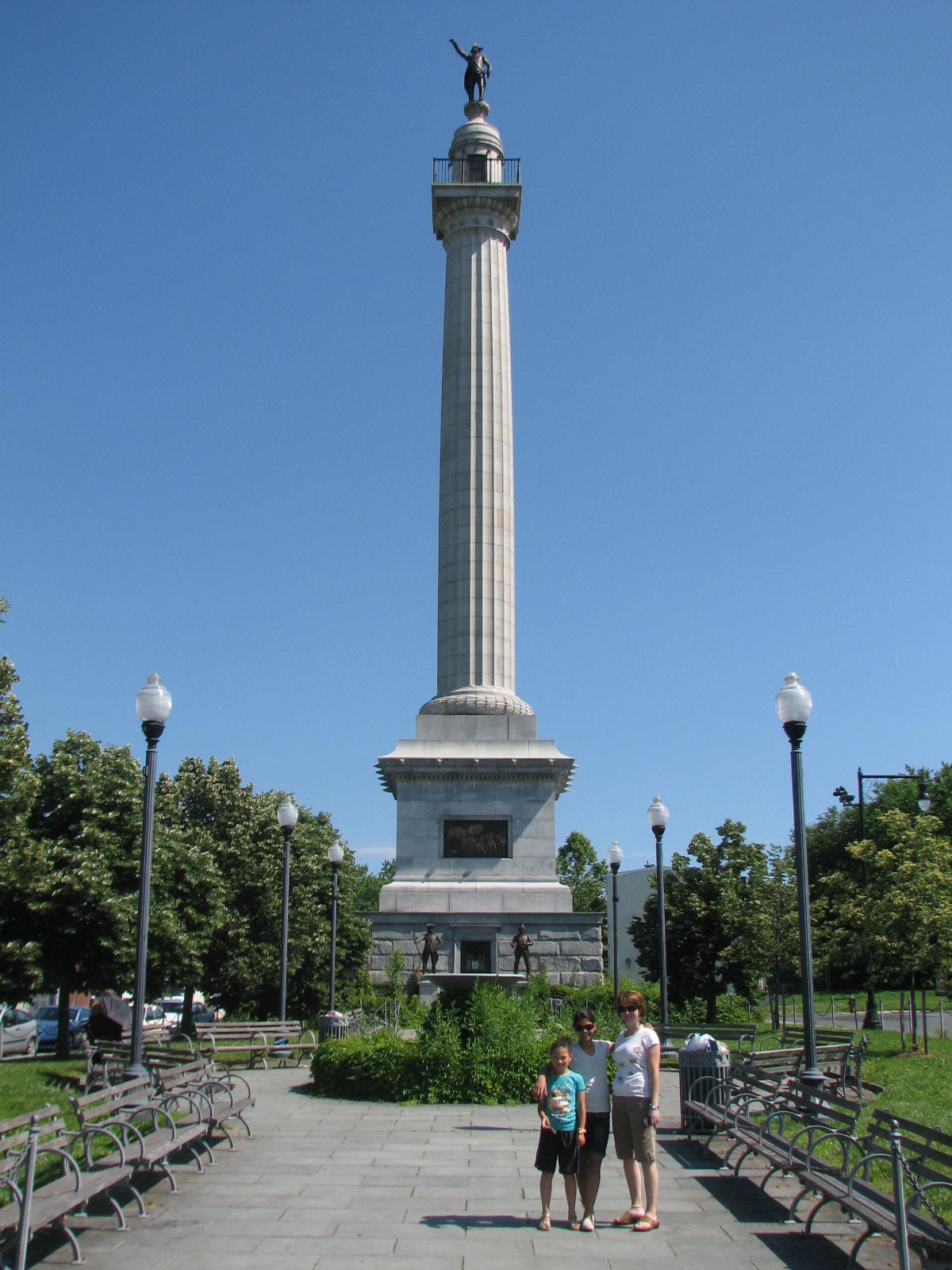
Trenton Battle Monument

Friday, December 4, 2015

Spotlight: Pennsylvania - Amish Country

Spotlight: The Amish are one of the most conservative religions in the world. The Amish are a group of traditionalist Christian church fellowships who broke away from the Swiss Anabaptists in 1693 under the leadership of Jakob Ammann. In the early 1700's, many Amish and Mennonite groups emigrated to upper Pennsylvania, where they eventually settled Lancaster County. From there, they spread to other settlements, most notably in Ohio and Indiana. The Old Order Amish continue to live as their ancestors did, valuing the traditional rural lifestyle that is passed on from generation to generation. Some of the most obvious aspects that distinguish the Amish from modern society include: speaking Pennsylvania German (sometimes called "Pennsylvania Dutch"), wearing homemade plain dress, eschewing modern technology including automobiles, TV, radio, telephones, computers, and power-line electricity, as well as adopting a policy of nonresistance (which prohibits them from serving in the armed forces). Despite all the restrictions, the number of Amish in North America grows annually. Members must choose to be baptized after they reach adulthood. Those who do not conform to the stringent community expectations must repent or face the consequences - excommunication or shunning.
     In 1954, the play "Plain and Fancy" became a smash hit on Broadway. In many ways, it introduced modern day society to the "oddities" of the simple life practiced by the Amish. Tourism ballooned from 25,000 annual visitors to more than 2,000,000 by the end of the decade as millions of tourists flocked to Lancaster County in order to see this "peculiar" way of life for themselves. Unfortunately, the area wasn't ready for such an influx of tourists, and many of the visitors ignored the rules of common decency by invading the privacy of the Amish by trampling through their fields and staring in kitchen windows in their search for anything Amish. Recognizing a great need, restaurateur Adolph Neuber purchased the 25-acre "Amish farm and house" next to his restaurant and opened it to the public in 1955 so that visitors could gain a proper and authentic understanding of the Amish people while still respecting their privacy. Today, as you travel through Lancaster County, it isn't difficult to spot these modern-day Amish traveling around town by horse and buggy, just like their ancestors have done for centuries.
Amish Farm and House
     The Strasburg Rail Road opened on June 9, 1832. The railroad began losing steam in the early 20th century with the advent of the electric trolley. The two world wars kept it running until mid-century. In 1958, it was purchased by a group of 24 stockholders who wished to preserve its rich history. On Jan. 4, 1959, the first passenger train in forty years departed from Strasburg Station, beginning a new era in the history of America's oldest shortline railroad.

Location: The Amish Farm and House is located on the eastern edge of Lancaster at 2395 Covered Bridge Drive, Lancaster. The Strasburg Rail Road is located just east of Strasburg at 301 Gap Rd, Ronks. Miller's Smorgasbord Restaurant is located at 2811 Lincoln Hwy E, Ronks.

Cost: The Amish Farm and House Tour - $9.25/adult (12-59), $6.25/child (5-11), $8.25/senior (60+)
- The Amish Farm Countryside Bus Tour - $20.95/adult (12+), $13.95/child, $4.95/toddler (0-4)
- The Strasburg Rail Road Day Pass - $18.00/adult (12+), $12.50/child (3-11); special event trains cost extra

Time: - The Amish Farm and House is open 9am - 5 pm daily. Allow 1-3 hours.
- The regular Strasburg Rail Road tours are about 45 minutes long and leave on the hour - usually 12:00, 1:00, and 2:00 except when they have extended summer and holiday hours.

Description: The Amish Farm and House tour is a minimum of 45 minutes. The tour teaches guests about the basics of Amish religious beliefs as well as shows them the details of daily life. Guests explore the house which includes the Front Room (which is used for worship services whenever the family's turn comes up in the rotation), the kitchen, and the bedrooms. The House was built in 1805, and was opened for tours 60 years ago. Although the tour guides are not Amish, they have all lived in Lancaster County most of their lives and are very knowledgeable about Amish culture. In addition to the house, visitors can go on a self tour of the grounds, which include a variety of animals and equipment that would be common on your typical Amish farm, as well as a few unauthentic playground attractions for tourists. Guests can also interact with resident artisans who introduce guests to many of the essential skills needed to keep a farm running smoothly. Included in the tour is the one-room Amish schoolhouse, where visitors can gain a greater appreciation of how and what Amish children are taught by interacting with a former Amish school mistress.
Amish bedroom (boy)
Amish Kitchen
Amish scooters
 

     The Strasburg Rail Road is the oldest shortline railroad in America. It was refurbished in 1959 as a passenger train (rather than freight) with an eye toward historical tourism rather than travel. The regular tour takes a short ride through Amish country, stops for passengers to get out and stretch their legs, then returns at the same relaxed pace. We did see the largest turkey farm in the U.S. as we passed by. We weren't around for any of the special events, but I assume they are more interesting. We were on a tight schedule, so we didn't tour the museum.


     Miller's Smorgasbord Restaurant opened in 1929 so that Anna Miller could serve passing truckers chicken and waffles while her husband repaired their rigs. The restaurant has grown in popularity as it retains its hometown quality, baking all their menu items from scratch. The most popular (and expensive) dining option is the smorgasbord (all-you-can-eat buffet). The food was absolutely delicious, which might explain why we saw Chuck Norris coming in as we were going out. They also have an interesting gift shop.

Rating: The Amish Farm and House - 4 stars
     The Strasburg Rail Road - 2 1/2+ stars (with a potential for higher for special events and/or some of the "fun extras" - see below)
     Miller's Smorgasbord Restaurant - 4 1/2 stars

Things You Should Know: - You can also purchase the premium package which includes the house, farm, and countryside bus tour at a discounted price.
- A variety of buggy rides, attractions and tours of Amish Country can be found at this website.
- Thomas the Train and Percy make periodic visits to Strasburg Station. Click here for more info.
- Other special events at Strasburg Rail Road include: The Great Train Robbery, Vintage Base Ball Day, Easter Bunny Train, The Rolling Antique Auto Event, Steampunk unLimited, Christmas Tree Train, Santa's Paradise Express, and The Night Before Christmas Train.
- Strasburg Rail Road is closed in January and runs on a limited schedule most of the year, so check the schedule before going to make sure that you arrive at the right time.
- Some "fun extras" for younger children at Strasburg Station include: Cranky Cars, Pint-Sized Pufferbelly trains, and a Pump Car.
- You can buy a combo ticket which includes a ride on the train as well as admission to the Railroad Museum of Pennsylvania (across the street) for an additional $3 for adults and 50 cents more for children.

Nearby: Dutch Wonderland, Lancaster County Central Park, Choo Choo Barn, National Christmas Center

Saturday, September 19, 2015

Spotlight: Philadelphia - The Betsy Ross House

Spotlight: Betsy Ross is best known for sewing the first U.S. flag - with 13 stars and 13 stripes. The account of this historic event was first made public in 1870 in a speech by William Carnby, one of Betsy's grandsons. He and several other family members signed sworn affidavits that they heard the account first-hand from Betsy's own mouth. According to the account, George Washington, Robert Morris and George Ross met with Betsy in 1776. Washington presented her with a piece of paper which contained a sketch of a flag with 13 red and white stripes, and 13 six-pointed stars. When asked if she could make a flag from the design, Betsy reportedly suggested that they change the stars to five points rather than six. They agreed, and she proceeded to sew the first U.S. flag. Although most historians claim that the account is fictional, it is the most commonly disseminated account of our flag's origin. Regardless of who produced the first version of the flag, it was officially adopted by the U.S. Congress on June 14, 1777 - Flag Day.
     The Betsy Ross House was built around 1740. It served as both a business and a residence for various artisans for more than 150 years. The first floor front room was used as a workshop and showroom, while the remainder of the house was used as a residence by the family. It is believed that Betsy Ross lived there with her family from 1776 to 1779. She was primarily an upholsterer, but supplemented her income by sewing flags, tents, musket cartridges, etc. during the war effort. Her family identified the building as the place where Betsy sewed the first U.S. flag. In 1898, while many other colonial era homes were being torn down to build newer buildings, a group of concerned citizens formed the American Flag House and Betsy Ross Memorial Association to raise funds to purchase the home. Once they purchased the home, a portion was turned into a museum and opened to the public. In 1937, the house went through massive renovations in an effort to restore it to its appearance when Betsy Ross's family lived there. The house was donated to the city of Philadelphia in 1941.

Location: 239 Arch Street, Philadelphia; it is within easy walking distance of Independence NHS

Cost: Audio tours: adults - $7.00; children/students/seniors/military - $6.00; Self-guided tours: adults - $5.00; children/students/seniors/military - $4.00

Time: About 30 min. - 1 hour; Open 10:00 - 5:00 pm daily

Description:  Visitors to the home can see seven rooms furnished with period antiques and reproductions, including the only interpretation of an 18th century upholstery shop in the country. Original Betsy Ross memorabilia on display include her: walnut chest-on-chest, Chippendale and Sheriton side chairs, eyeglasses, quilted petticoat and Bible. They can also speak to "Betsy" herself as she works in her workshop. An audio tour, narrated by "Betsy," tells about her life as a business woman, revolutionary, mother and wife, helping the visitor gain a better appreciation of what life was like for the working class in the 18th century.
     The grounds include an annex building, a civic garden, a fountain, and the tombs of Betsy Ross and her third husband, John Claypoole. Visitors can mingle with History Makers and hear stories from our nation's history.

Rating: 3 stars (out of 5)

Things You Should Know: - Groups of 20+ visitors are eligible for discounted group rates.
- The house is closed on Mondays from December - February.
- Kids' audio tours include 13 "history mysteries" (age 4-8).
- The Betsy Ross House is currently hosting a special exhibit entitled: A Museum in the Making: The American Flag House & Betsy Ross Memorial Association, 1898-1941. It will be open until January 2016.
- You can't take pictures inside the house.
- The Betsy Ross gift shop sells flags that have been flown over the Betsy Ross House.
- Concessions are available in the courtyard from May 1 - Labor Day.

Nearby: Independence Park NHS, Christ Church Burial Ground (Ben Franklin), Arden Theatre Company, The Franklin Fountain (old style ice cream shop)

Saturday, September 12, 2015

Spotlight: Philadelphia - National Constitution Center

Spotlight: Although the National Constitution Center is not officially part of Independence National Historical Park, it is located nearby in Independence Mall and can easily be incorporated in your day's itinerary. The center functions as a National Town Hall, hosting government leaders, journalists, and scholars for public discussions and debates regarding the laws of government. It first opened on July 4, 2003.

Location: The National Constitution Center is located in downtown Philadelphia at 525 Arch Street.

Cost: $14.50/adult, $8.00/child (4-12), $13.00/youth (13-18), $13.00/senior (65+)
- Admission is free with purchase of the Philadelphia City Pass.

Time: Mon. - Fri. (9:30 am - 5:00 pm); Sat. (9:30 - 6); Sun. (noon - 5 pm). Allow between 1-3 hours.

Description: The National Constitution Center is dedicated to “disseminate information about the United States Constitution on a non-partisan basis in order to increase the awareness and understanding of the Constitution among the American people.”
     In order to accomplish this objective, the center has dozens of interactive exhibits that teach visitors about U.S. government. The three main exhibits are Freedom Rising, The Story of We the People, and Signer's Hall.
     As part of your price of admission, visitors get to view the fabulous multimedia theatrical presentation called Freedom Rising. This impressive 17-minute presentation takes viewers on a journey highlighting the way the Constitution has molded U.S. history from 1787 to the present.
     The Story of We the People guides visitors through milestones in U.S. history. The American National Tree highlights 100 individuals who have helped shape constitutional history. Artifacts include a rare copy of the Emancipation Proclamation, FDR's fedora, and Sandra Day O'Connor's Supreme Court robe.
     The other permanent exhibit is Signer's Hall. Here you can sign a modern copy of the Constitution amid a room full of life-size bronze statues representing the 42 original signers of the Constitution, including George Washington, Ben Franklin, and James Madison.


There are dozens of other exhibits and activities that are rotated through on a temporary basis. For example, one of the many activities is Hail to the Chief - a jeopardy style game in which participants test their knowledge of U.S. Presidents. You can also take the Oath of Office, committing yourself to uphold the Constitution.


Rating: 4 1/2 stars (out of 5)

Things You Should Know: - Admission is FREE on Constitution Day (Sept. 17).
- The National Constitution Center offers a variety of constitutional seminars, discussions, course materials, and digital resources for students of all ages.
- Photography and video are prohibited throughout the museum except for Signer's Hall, where visitors are encouraged to take a picture with their favorite Founding Father.

Nearby: Franklin Square, Adventure Aquarium, Chinatown, Penn's Landing

Saturday, September 5, 2015

Spotlight: Philadelphia - Independence National Historical Park

Spotlight: The first thing most people think about when they think of Philadelphia is the Declaration of Independence. This document was produced by the Second Continental Congress which convened in Independence Hall after war broke out. The document was formally adopted by the Congress on July 4, 1776, which was later adopted as the birthday of the new nation that would be created as a result of the 13 colonies gaining independence from Great Britain in the Revolutionary War. Independence Hall was again the primary meeting place of the Constitutional Convention, which was convened in 1787 for the purpose of revising the Articles of Confederation. Instead of just revising the document, the group of diplomats created a whole new form of government. The laws and systems of this new government were spelled out in the U.S. Constitution - a document that would become a standard upon which all modern day democracies are modeled. These two documents have molded not only the history of the United States, but have influenced political ideology around the globe and have channeled the course of history throughout the entire world. Independence National Historical Park preserves Independence Hall and its accompanying sites for future generations to ponder the impact of these documents as well as the birth of a new nation - the United States of America.

Location: Independence Hall is located in downtown Philadelphia at 520 Chestnut St., and is located in the principal section of Independence National Historical Park. Several other buildings are located at Franklin Court on Market Street.

Cost: Most sites in the park are free. The Ben Franklin Museum charges a modest fee of $5/adult & $2/child (4-16).

Time: About 2-4 hours for Independence Park. There are plenty of other things of interest within walking distance to take up a full day of sightseeing. The Independence Visitor Center is open from 8:30 am - 6:00 pm daily. Other exhibits are open from 9:00 am - 5:00 pm. Between May and September, the most popular exhibits remain open until 7:00 pm.

Description: Independence National Historical Park is often described as "America's most historic square mile." It is a conglomeration of important buildings and exhibits relating to the birth of the United States. The main section of the park is located at Independence Square, which includes several popular exhibits:
     Independence Visitor Center - This is the place to start your tour. Not only can you get tickets to Independence Hall, but you can also peruse the exhibits, watch films, and get information on special events and tours that are available.
     Independence Hall - This building played an important role in creating the United States of America. It was here that both the Declaration of Independence and the U.S. Constitution were drafted, signed, and ratified. Access to the rooms are only available through the official tour.


     Congress Hall - This building served as a meeting place for both houses of Congress (the Senate and House of Representatives) from 1790-1800. Important events that occurred here include the admittance of 3 states into the Union, ratification of the Bill of Rights, the presidential inaugurations of George Washington (1792) and John Adams (1796), the establishment of a Bank of the U.S., the Federal Mint, and the Department of the Navy.
House of Representatives
Senate chambers
     Great Essentials Exhibit - This exhibit displays existing copies of the Declaration of Independence, the Articles of Confederation, and the U.S. Constitution, as well as the inkstand that was used to sign the Declaration.
     Old City Hall - Built as the City Hall of Philadelphia, the building was used by the U.S. Supreme Court from 1791-1800.
     Liberty Bell Center - This building houses the original Liberty Bell that hung in Independence Hall until 1876, when it was replaced by the Centennial Bell. There are also exhibits and a video presentation.
     Presidents House Site - Here you can view the historic foundations of the house where both George Washington and John Adams lived with their families and staff while serving as Presidents of the United States.
     A blocks and a half east of Independence Square is Franklin Court. This section of the park includes a steel "ghost structure" outlining the spot where Benjamin Franklin's home once stood, the Benjamin Franklin Museum, the Franklin Court Printing Office, the first U.S. Post Office, and an architectural/ archaeological exhibit.
First US Post Office
Franklin Printing Press
     Other nearby buildings indirectly associated with the Park include: Benjamin Franklin National Memorial, Bishop White House, Carpenters' Hall, Christ Church, City Tavern, Declaration House, Edgar Allan Poe NHS, Free Quaker Meeting House, Germantown White House, Gloria Dei Church, Independence Archaeology Lab, Merchants' Exchange Building, National Constitution Center, New Hall Military Museum, Philosophical Hall, Second Bank of the United States, Thaddeus Kosciuszko National Memorial, Thomas Bond House, Todd House, and Washington Square.

Rating: 5 stars (out of 5)

Things You Should Know: - Although there is no charge to go on a tour of Independence Hall, you do need to obtain a "timed entry ticket" from the Independence Visitor Center (except during the months of January and February). You can order them ahead of time, but there is a holding fee ($1.50/ticket).
- You must pass through security checks before entering Independence Hall. You should arrive 30 minutes before your timed entry to make sure that you make it through security before your tour starts.
- One of the best times to visit is during Philadelphia's annual 10-day Independence Day celebration.
- Leashed pets are allowed on park grounds, but not permitted into any buildings.
- There is an underground parking lot under the Independence Visitor Center.
- You can't take pictures of the original documents in the Great Essentials Exhibit because the flash deteriorates the documents.
- Ben Franklin's grave is at Christ Church. It is a fad to toss pennies onto his tomb.

Nearby: National Constitution Center, U.S. Mint, Betsy Ross House, City Tavern