Saturday, September 14, 2024

Spotlight: Royal Palace of La Granja de San Ildefonso

Spotlight: This Royal Palace of San Ildefonso, known as La Granja, is located in the small town of San Ildefonso, about 10 km. east of Segovia, and 80 km north of Madid. The palace was built in the early 18th century, during the reign of King Felipe V, the first Spanish king of the French Bourbon Dynasty, who rose to the throne following the death of Carlos II, who had no male heirs. Felipe, who was homesick for his native France, began building the palace and gardens based on the famous Palace of Versailles. Teodoro Ardemans was chosen as the first architect for the project, but was later succeeded by Andrea Procaccina, and finally Filippo Juvarra. The palace was designed, in the Rococo architectural style, as a quiet retreat for Felipe, who planned to retire there. However, when his successor, King Louis I, unexpectedly died, Felipe was drawn out of retirement, and his quiet retreat became an important meeting place for the King, his advisors and the Spanish Court. The small town of San Ildefonso grew to provide for the needs of the many courtiers who arrived to pay homage to the reagent. Some of these expansions included military barracks, a collegiate church and a royal glass factory. Following Felipe's death, the palace served as the primary summer residence of the royal family until the 1880's. Although much of the palace was burned during a fire in 1918, it has been restored to appear as it did during its heyday. The Palace is part of the Patrimonio Nacional of Spain, which maintains many of the Crown's lands, and is currently used as a museum.

Front view of La Granja

Royal Palace of La Granja de San Ildefonso

View from the top of Cascada Nueva

    One of the key attractions of the Palace are its extensive gardens and fountains. The gardens extend over 1,500 acres, and were designed by Rene Carlier in the Jardin a la francoise style, which was popular throughout Europe in that era. The gardens include 26 sculptural fountains which feature themes from classical mythology, particularly in the Greek tradition. The fountains are made of lead, to avoid corrosion, but painted to look bronze or marble. The original waterworks are still functional, relying on gravity to project water up to forty meters in height. However, most days only a few fountains are in operation.

The Cascada Nueva fountain

The gardens of La Granja

The fountains are rarely on; but the artwork is beautiful

Location: Real Sitio de San Ildefonso

Cost: 9 euros; entrance is free on Wednesdays and Sundays from 3:00 pm to 7:00 pm

Time: open daily Tuesday - Sunday from 10:00 am to 7:00 pm (last entry at 6:00 pm); the gardens stay open later based on the month; closed Mondays

Rating: 5 out of 5 stars

Things you should know: - A few fountains are operational daily from April to mid-October. The Diana Baths is usually operational on Saturday evenings. All 26 fountains are in operation twice a year - on the Feast Days of San Fernando (May 30) and San Luis (Aug. 25).

- Transportation to San Ildefonso is available by bus from Madrid (Avanza) or Segovia (Linecar)

- Unfortunately, photography is not allowed inside the Royal Palace. However, you can see what some of them look like, as well as the fountains on display at this link: https://www.gettyimages.com/photos/san-ildefonso-palace

Nearby: Madrid - Spain's capital (80 km SE of San Ildefonso); Segovia (10 km to the west of San Ildefonso); Royal Monastery of San Lorenzo de El Escorial - a royal site where most of the kings and queens of Spain are entombed (59.6 km south of San Ildefonso); Castillo de Manzanares - a beautiful medieval castle (41.5 km SE of San Ildefonso)

Saturday, September 7, 2024

Spotlight: Segovia, Spain

 Spotlight: Located along the Eresma River near the Sierra de Guadarrama mountain range, Segovia is located 91.6 km northwest of Madid. Segovia is a fortified city in Castilla-Leon - with a fortified castle and city walls extending from the castle around the city center. Queen Isabella was crowned Queen of Castilla-Leon in 1474 in the church of San Miguel de Segovia near Segovia's Plaza Mayor. Queen Isabella and her husband, King Ferdinand of Aragon, united northern Spain and conquered the Muslim kingdoms in Andalucía (southern Spain) to create the modern nation of Spain. 

    Segovia is probably my favorite city in Spain. The city center of Segovia, and its famous aqueduct, were both declared World Heritage Sites by UNESCO. The city center contains many historical buildings of civil and religious importance - including a number of historical Jewish sites within the Old Jewish Quarter. The most famous monument is the Aqueduct of Segovia in the Plaza de Azoguejo. The aqueduct dates back to the early second century A.D. and is the best preserved roman aqueduct in all of Spain. It is an awesome example of the Roman's engineering prowess, with about 25,000 granite blocks held together by gravity (without the use of mortar!), spanning 818 meters with 167 arches, the tallest measuring 29 meters. The aqueduct remained in use until 1973, and received its designation as a World Heritage Site in 1985. If you follow the aqueduct to where it intersects with the city walls, you can climb the stairs to get more amazing views of the aqueduct from a different angle.

The Aqueduct of Segovia

View of the aqueduct from the city walls

- Location:: Pl. Azoguejo, Segovia
- Hours: always open
- Cost: free
- Rating: 5 of 5 stars


Activities: 
"La Dama" - La Catedral de Segovia: Segovia's cathedral is considered the last Gothic-style cathedral built in Spain, and blends four different styles: Gothic, Renaissance, Baroque and Neoclassical. Construction was started in 1525, under the supervision of Juan Gil de Hontanon, but the cathedral wasn't dedicated until 1768. The cathedral was built on a hill near the city center and the tower, measuring 108 meters, became the tallest tower in Spain upon its completion. The cathedral houses 22 chapels, with 161 stain glass windows and 167 pinnacles.
- Location:  C/ Marques del Arco, 1, 40001 Segovia
- Hours: 9:00 am - 9:30 pm (Mon. - Sat.); 1:30 pm - 9:30 pm (Sun.)
- Cost: 4 euros
- Rating: 3.5 of 5 stars

La Dama - Segovia's cathedral

The Alcazar of Segovia: The Alcazar is a medieval castle built on a stone peninsula overlooking the confluence of the Eresma and Clamores rivers, offering a fantastic view that provided both aesthetic and military value. Segovia's city walls flanked the castle walls until they reach the back wall, creating the illusion of a giant ship with the castle located at its bow and the aqueduct jutting out like a rudder. The castle was built around the 12th century A.D. and was the home to 22 kings as well as many other historical figures. Statues depicting these kings and queens adorn the Monarchs Room. The castle was designated as the Royal Artillery College in 1764, until an accidental fire gutted many of its rooms in 1862. When the castle was restored to its 15th century glory (when Isabella sat on the throne), it was turned into a museum and National Archive. The Homage Tower once housed the famous treasure of the Crown of Castile, which was used to fund the voyages of Christopher Columbus. In modern times, the castle served as one of the models for Walt Disney's Cinderella Castle at Disneyland.
- Location: Pl. Reina Victoria Eugenia, s/n, 40003 Segovia
- Hours: 10:00 am - 8:00 pm (summer); 10:00 am - 6:00 pm (winter); closed for major holidays
- Cost: 10 euros
- Rating: 5 of 5 stars

The Alcazar of Segovia
(as seen from the valley below)


castle garden - Alcazar

The Alcazar was one of the castles that
inspired Walt Disney's Cinderella Castle


The Monarchs Room - Alcazar

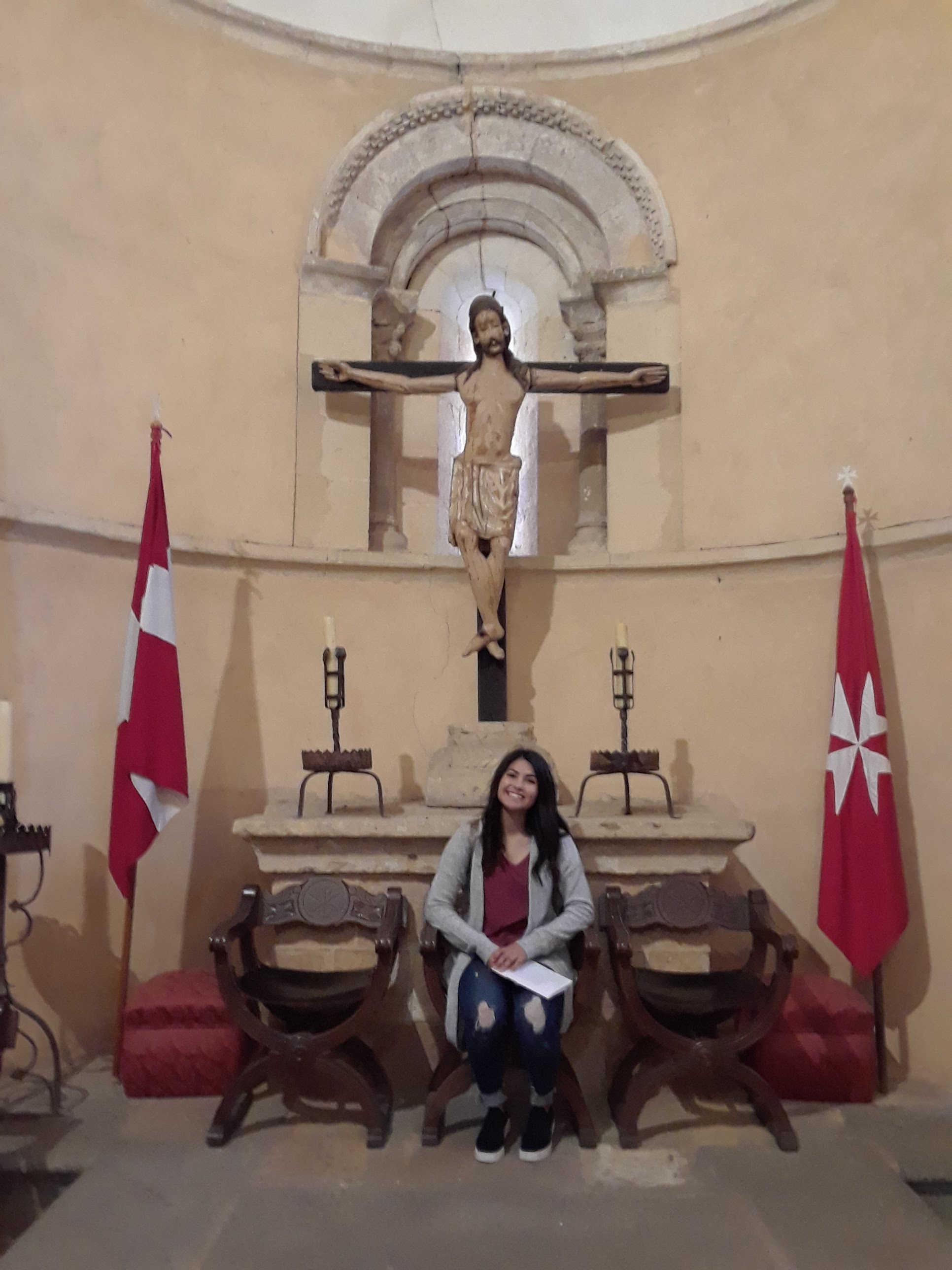
The Iglesia de Vera Cruz: The Church of the True Cross is a Roman Catholic church built by the Knights Templar in 1208 in the Romanesque style - a 12-sided polygon with 3 semicircular chapels, reminiscent of the Holy Sepulcher in Jerusalem. Inside the church is a two-story gallery. According to legend, the Knight Templar would stand guard in this shrine, protecting a fragment of wood that was said to come from the true cross of Jesus Christ. However, the fragment of wood is no longer housed here, but the shrine remains a popular tourist destination.
- Location: Tr.ª Zamarramala, s/n, 40003 Segovia (in the valley below the Alcazar of Segovia)
- Hours: 10:30 am - 1:30 pm; 4:30 pm - 6:30 pm (Wednesday - Sunday; closed Monday and Tuesday)
- Cost: 1.20 euros (free on weekends and holidays)
- Rating: 3 of 5 stars
La Iglesia de la Vera Cruz

Inside the Church of the True Cross

La Real Casa de Moneda: The Coining House was previously the Royal Mint, and dates back to the 1500's. The mint was commissioned by Felipe II, and built on the shore of the Eresma River to take advantage of the new technique of minting coins using hydraulic-powered machinery. This was the first mechanized factory in Spain and remained in use until 1869. The Coining House is now a museum, which demonstrates the evolution of coin making from ancient times up to the 20th century. The grounds of the Mint contain the "Garden of the King" - one of the favorite spots of King Felipe II. It was declared a World Heritage Site by UNESCO in 1985.

- Location: C. la Moneda, s/n, 40003 Segovia (in the valley below the Alcazar of Segovia)
- Hours: 10:00 am - 2:00 pm; 4:00 pm - 6:00 pm (Wednesday - Sunday; closed Monday and Tuesday)
- Cost: 4.50 euros
- Rating: 4 of 5 stars

Real Casa de Moneda water wheels


Old Spanish coins

Things you should know: Segovia wasn't built with cars in mind. Travel around the city is best done on foot since it is almost impossible to find parking spaces near where you want to go. In fact, when we did try to drive down one street, it was so narrow that the walls on both sides of the street were covered with scrapes from cars that got a little too close, and a gouge was carved out of the stone wall in order to allow the cars' mirrors to squeeze through.
A narrow street in Segovia

- Segovia is famous for its cochinillo (roast pig). One famous restaurant demonstrates the tenderness of the meat with a small ceremony in which the waiter cuts the pig with a plate, then smashes the plate on the floor. I'm not sure why they smash the plate, but it's part of the spectacle.


Nearby: Madrid - Spain's capital (91.5 km SE of Segovia); The Royal Palace of San Ildefonso (10 km to the east of Segovia); Castillo de Manzanares - a beautiful medieval castle (51.5 km SE of Segovia), Castillo de Coca - another beautiful medieval castle (62 km NW of Segovia) and Castillo de Mota - another interesting medieval castle (94.5 km NW of Segovia)


Sunday, September 1, 2024

Spotlight: Toledo, Spain

Spotlight: Located along the Tagus River, 72.4 km southwest of Madrid in central Spain, Toledo is one of the most important cities in the history of the Iberian peninsula. Following the fall of the Roman Empire, the invading Visigoths made it their capital from 542-725 AD. It is currently the capital of the province of Toledo in the region of Castilla-La Mancha.

Toledo

     Toledo is known as the "City of the Three Cultures" due to is historical ties with Christian, Muslim and Jewish communities within its borders. All three cultures have influenced the development of the city and their influences are still obvious today in the architecture and historical treasures. In 1986, the city of Toledo was declared a UNESCO World Heritage Site for its monumental and cultural heritage.
The Synagogue of Santa Maria la Blanca

     During the Roman era, the city of Toletum was incorporated into the Roman Empire, and the city officials were given Roman citizenship. The Romans built a circus, city walls and a public bath. Over the centuries, many relics of the Roman era have been buried underneath the modern city, but archeologists are busy excavating these sites to bring these treasures back to light.
Archeological dig site

     From ancient times, much of Toledo's economy was built around metal-working. The swordsmiths of Toledo became renowned for their ability to make the highest quality blades in all of Europe. Hence it was chosen as the homeland of the fictional Inigo Montoya in William Goldman's literary masterpiece - The Princess Bride. Today, swords made in Toledo are one of the most popular souvenirs among tourists.
Swords of Toledo

Activities: 
Santa Iglesia Catedral Primada de Toledo: Toledo's cathedral opened in 1493, combining Baroque and Mudéjar styles common to the region. The altar, a medieval masterpiece (named El Transparente) was created by Narciso Tome. It is several stories high and features fantastic figures of stucco, paintings, bronze castings and several colors of marble.
- Location:  Calle Cardenal Cisneros, 1, 45002 Toledo
- Hours: 10:00 am - 6:30 pm (Mon. - Sat.)
- Cost: 12 euros
- Rating: 4 of 5 stars
Toledo Cathedral

El Transparente

The Alcazar: Built on the highest point in the city, the Alcazar is a stone fortification measuring 60 meters on each side. Originally a Roman palace, it was restored by Charles I, who received Hernan Cortez there following his conquest of the Aztec Empire. More recently, it was the site of an important battle during the Spanish Civil War in the 1930's. After the war, it was restored and converted into the regional library.
- Location: C. de la Union, s/n, 45001 Toledo
- Hours: 10:00 am - 5:00 pm (closed on Mondays)
- Cost: 5 euros
- Rating: 3 of 5 stars
Alcazar de Toledo

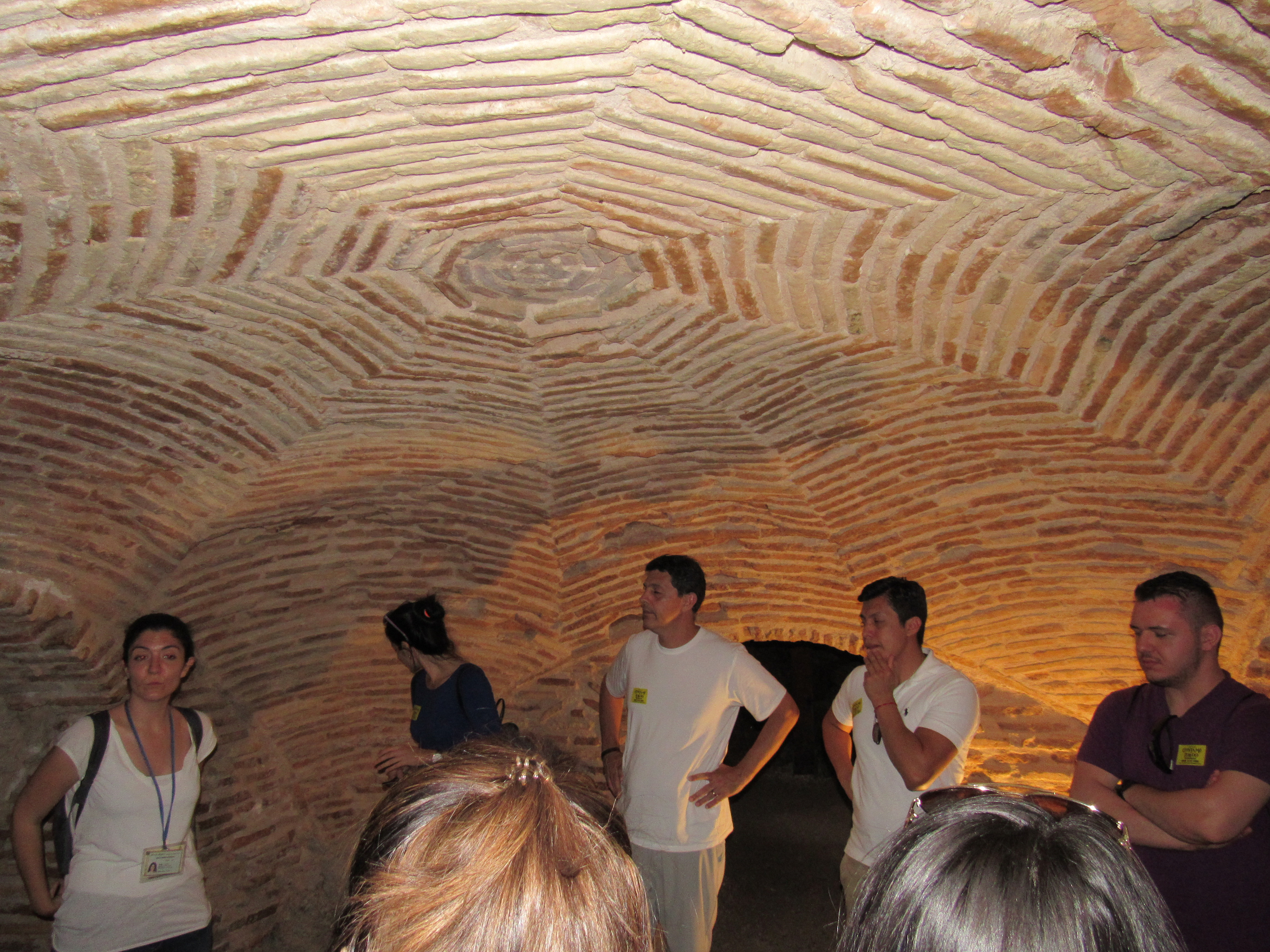
Subterranean Tour: One of the most interesting tours we went on was the Subterranean Tour. Although the five sites we visited weren't connected, they each had a unique place in Toledo's rich history: an old jail, Arabian baths, Roman baths, a Jewish home and a well. The hydraulic system that replaced the old Roman aqueduct was so ingenious that only the engineer who built it was capable of repairing it. After he died, it fell into disrepair and people had to revert back to carting water up to the city from the river by burro.
- Various tour groups offer variations of this tour. Prices, locations and schedules will vary based on the vender.
- Rating: 4 of 5 stars

Basement of a Jewish house where the Jews practiced their religion in secret.

Fly Toledo: A purely fun adventure we went on the a zipline across the Tagus River. The zipline is anchored to the city wall on one side and crosses the river to a wooden platform constructed for the purpose of landing. 
- Hours: 11:00 am - 6:30 pm (winter); 11:00 am - 8:00 pm (summer)
- Cost: 12 euros; professional photo - 3 euros
- Limits: single passengers must weigh between 20-120 kg (44-264 lbs.)
- Rating: 4 of 5 stars
Fly Toledo zipline

Mirador del Valle: One of the best spots in Toledo is the Mirador del Valle - a lookout spot that offers an awesome view of the city. The Mirador is located on the bank opposite of the city. We took an excellent hike along the river before crossing over to the Mirador shortly before sunset. When the lights lit up the city, the view became magical. Just make sure you have a flashlight for the walk back!
- Location: On the southern banks of the Tagus River across from Old Town.
- Hours: open 24 hours
- Cost: none
- Rating: 5 of 5 stars
Mirador del Valle


View of Toledo from Mirador del Valle at twilight

Things you should know: Toledo wasn't built with cars in mind. Travel around the city is best done on foot since it is almost impossible to find parking spaces near where you want to go. It's also the best way to discover the fascinating nooks and crannies of the city.
- If you purchase a sword, the best way to get it home is probably shipping it by boat.
Walking path between buildings

Nearby: Madrid - Spain's capital (72.4 km NE of Toledo); The Royal Palace of Aranjuez (45 km to the east of Toledo); The classical windmills of Consuegra - the land of Don Quijote de La Mancha (63.4 km SE of Toledo), and Talavera de la Reina - a town that dates back to Roman times and is famous for it's ceramic artisanry (79.8 km to the west of Toledo).


Tuesday, June 30, 2020

Travel Tip #60 - Should you Buy the Travel Insurance?

     Typically, I don't purchase warranties, product insurance or travel insurance. I figure that the people offering the warranty are making money off of the deal, so you would be much better off saving the money in your own little emergency fund that over time will more than cover any benefits you would have gotten from a successful claim or two.
     Last fall, my mother needed a travel companion for a tour she wanted to take in Israel. I agreed to go with her and we purchased the tickets 6 months ahead of time. Since my mother felt strongly about buying the travel insurance, we did it. A few months later, the CO-VID 19 virus started spreading in China. Our tour guide monitored the situation closely and finally decided to cancel the tour about a month before we were supposed to go. We immediately filed a claim, feeling lucky that we purchased the insurance. It was the start of a 3 1/2 month headache.
     Within a couple of weeks, we got a notice from AIG (the company who sold us the insurance) saying that our claim had been denied because it didn't exactly fit the description of what was covered as specified in the fine print. By the time we received notice of the denial, additional factors had occurred that we felt strengthened our case: Israel had issued a mandatory 2-week quarantine of all visitors; Israel then shut their doors to all foreigners; Austria (where we were supposed to have a layover) was closing its borders to foreign visitors; and then our flight was cancelled. Armed with all these additional factors, we resubmitted our claim. Again it was denied, citing their very specific fine print of which cases would covered and claiming that our situation didn't qualify.
     I was incensed. This time I called the company and voiced my complaints. The lady I talked to said that I shouldn't worry about it because the airlines would grant us credit for the cancelled flight. I explained that we didn't want the credit because we weren't sure when or if we would have the opportunity to use it within their time frame and that because we had purchased the insurance we deserved a complete refund. When she informed me that she wasn't authorized to grant our claim, I asked to speak to her supervisor. I was placed on hold for an hour without any indication that the call would ever be continued and finally hung up.
     We filed a third claim, submitting additional documentation that showed that our situation did indeed meet the conditions in the fine print, but this time, we got the runaround. The different people assigned to our case kept requesting documentation that we had already submitted and took weeks to respond to our e-mails despite their company's assurance that most requests receive answers within 10-15 days. We decided to recruit help by filing a complaint with the California Department of Insurance. Finally, 3 1/2 months later, we got an e-mail saying that our claim had been granted. I'm not sure what eventually coerced the company to finally grant our claim; but we were pleasantly surprised, having already given up any hope of seeing the money again.
     Should you buy the travel insurance? That's up to you. All I know is that I will never again purchase travel insurance that is conditional upon the fine print.
   

Sunday, July 21, 2019

Spotlight: Houston - The Johnson Space Center & Space Center Houston (NASA)

Spotlight: Fifty years ago (July 20, 1969) was one of those landmark dates in history - the day man walked on the moon. Neil Armstrong, the first human being to step on a extraterrestrial landmass, stated, "That's one small step for [a] man, one giant leap for mankind."
Apollo 11 crew
     The National Aeronautics and Space Administration (NASA) was founded in 1958 as an independent organization of the U.S. Federal Government. The new agency was given the directive to pursue peaceful applications in space science; including the Apollo Moon Landing missions, the Skylab space station, the Space Shuttle, supporting the International Space Station, overseeing the development of the Orion Multi-Purpose Crew Vehicle, the Space Launch System and Commercial Crew vehicles.
     The Johnson Space Center in Houston, Texas is the central hub of NASA operations, but is just one of several facilities run by the organization throughout the nation.

Location: The Johnson Space Center is located at 2101 E. NASA Parkway in Houston, TX - about a 30-minute drive from downtown Houston.

Cost: Space Center Houston ticket prices: adults - $29.95, children (4-11) - $24.95, seniors (65+) - $27.95. An audio tour option is available for an additional $6/ticket.

Time: The Space Center is open from 10am - 5pm on weekdays and 9am - 6pm on weekends. During the summer, it stays open an extra hour on weekdays. Plan on spending at least a half-day there. Space geeks could spend a full day there and still want more.

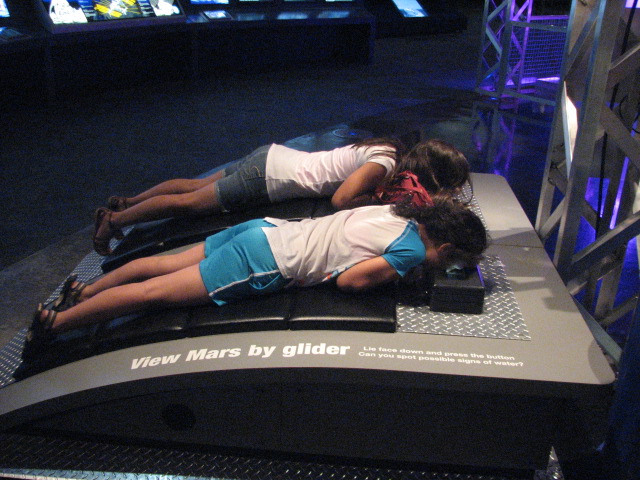
Description: The Johnson Space Center has a variety of fun activities. When we went in 2014, they had a Mars exhibit with different activities that simulated the Martian environment. We did the Mars Walk, a Freefall, a glider ride simulation, etc.
Mars Walk

Glider simulation

Freefall
     There were lots of hands on displays that allowed you to perform several tasks that astronauts had to perform remotely or in the confines of their space suits. The girls also got to experience a blastoff simulation.


Blastoff
     Naturally, we went on a tour of the space station, which included the Astronaut Gallery, the Mission Control Center, and several buildings that housed outdated space equipment at Rocket Park. By inspecting them up close, you get a good idea of how massive some of these vehicles are.
Saturn Rocket

Mission Control Center

cockpit of Space Shuttle Independence
Rating: 5 stars (out of 5)

Things You Should Know: - In order to visit the Johnson Space Center, you must book a tour through Space Center Houston.
- The Zero-G Diner is available if you are there through lunch time.
- The grounds are huge, and you probably won't have time to do everything. The top attractions at Space Center Houston include: 1) The Orion Simulator and Starship Gallery; 2) The Moon Rock Gallery; 3) Independence Plaza; 4) The Neutral Buoyancy Lab; 5) Mission Control; 6) Space Vehicle Mockup Facility; and 7) Rocket Park.
- Keep tabs on the time so that you don't miss out on your timed Independence Plaza tour of the space shuttle as well as your tour of the Johnson Space Center.
- The Johnson Space Center is still actively used to prepare astronauts for space exploration. The Orion program is currently preparing to send humans to the Moon, Mars and beyond.
- For a detailed itinerary of how to spend your day, click here.

Nearby: Downtown Aquarium, Dolphin Excursion, Minute Maid Park, Nolan Ryan Museum

Sunday, December 2, 2018

Spotlight: Anchorage - Tony Knowles Coastal Trail

Spotlight: The Tony Knowles Coastal Trail is one of the most beautiful coastal trails in the nation. The eleven mile trail goes from Elderberry Park to Kincaid Park and only has slight elevation changes along its course. Open all year, the trail is popular for a wide variety of activities: hiking, biking, rollerblading, jogging and even skiing. Keep your eyes open along the trail and you might spot moose, whales, eagles, or even a wolf. The Trail features a portion of the Anchorage Light Speed Planet Walk, designed to show to scale the size of the planets and their relative distance to the sun. Each step is roughly equivalent to the distance light travels in one second.

Location: The Tony Knowles Coastal Trail begins at Elderberry Park at 1297 W. 5th Avenue (in the northwest section of Anchorage), and winds its way 11 miles along the coast to Kincaid Park at 9401 Raspberry Road on the western part of the city (just southwest of the airport).

Cost: The trail is free, but I would recommend renting a bike since there are a couple of bike rental shops nearby.

Time: You can spend as little or as much time as you like exploring the trail and the parks along the way, but most people will probably spend 2-4 hours. To walk the entire distance of the Anchorage Light Speed Planet Walk (see link above) will take you about 5 1/2 hours (each way).

Description: After renting bikes, we made our way to the trailhead at Elderberry Park. We then continued along the paved trail through the mud flats along the northern side of the trail (by the bay). It was nice, but I wasn't overly impressed. We stopped to look at the salmon run at Chester Creek, then continued on, admiring the mansions along the southern side of the trail. Soon it entered a forested section of the trail which was stunning. At that point, you would have no clue that Alaska's largest city was only a couple of miles away. We took the turnoff to explore Earthquake Park, which revisits the devastating earthquake of 1964 which reached a magnitude of 9.2 the largest quake ever recorded in North America. From there the trail went around the airport to Kincaid Park, but we turned around because the rain was picking up and we were wet and cold.


Rating: 4 stars (out of 5)

Things You Should Know: - Be prepared for precipitation or cold. The weather can change suddenly, so you should dress in layers and have a poncho handy.
- Although Pablo's Bike shop is closer, we found better prices at another shop just north of the train station.
- Anchorage is decked out in beautiful wild flowers during the summer months.
Resolution Park (statue of Captain James Cook)

wild flowers
Nearby: Westchester Lagoon, Alaska Aviation Museum, Lake Hood Seaplane Base, Resolution Park
Lake Hood Seaplane Base

Sunday, October 28, 2018

Spotlight: Alaska Wildlife Conservation Center

Spotlight: "The Alaska Wildlife Conservation Center is a nonprofit organization that takes in orphaned and injured animals from the wild and provides refuge for them. With the purchase of an admission ticket, you can choose between driving the 1.5-mile loop or enjoy your time and walk through the beautiful landscape. Our resident animals include brown bear, black bear, moose, muskox, caribou, wolves, birds, porcupine, wood bison, elk and more! Free to all visitors is the daily animal programs that show an in-depth interaction between animal care staff and our resident animals." The Center is located on about 700 acres at the head of the Turnagain Arm at the entrance to Portage Valley along the Seward Highway. Originally opened in 1993 as Big Game Alaska, it became a non-profit organization in 1999 and renamed itself the Alaska Wildlife Conservation Center.

Location: The Conservation Center is located at Mile 79 Seward Highway near Girdwood south of Anchorage.

Cost: $15/adult (18-64), $12/seniors & active military, $10/youth (7-17); The Walk on the Wildside Tour costs $100/person (includes price of admission)

Time: Open daily, but hours of operation vary from month to month. Plan on spending about 2 hours.

Description: The Conservation Center was a last-minute addition to our trip, yet one of the neatest things we did. The enclosures are much larger than most zoos, allowing the animals to roam freely within their habitats. Boardwalks and high fences allow visitors to get close up views of the massive animals that include grizzly bears, black bears, moose, elk, bison, caribou, wolves and more than a dozen other creatures. Although you can drive the 1.5 mile loop, we decided to walk it so as to go at our own pace without worrying about who was behind us or trying to find a parking spot at the designated areas.
Elk

Muskox

Black Bear
     My favorite habitat was the grizzly bears. As we walked along the raised boardwalk we spotted one of the grizzlies lounging in the stream. Suddenly, the other grizzly came around a bend in the hill about ten meters away. The first grizzly hopped up and the two stared at each other for about five seconds before the second one started chasing the first one. When he caught up with the first one, they wrestled for a bit before resuming their own separate activities.
Grizzlies sizing each other up


     We also really enjoyed watching the wolves getting fed. When we first walked by the wolf enclosure, we couldn't see any wolves; which apparently were hiding in the tall grass. As soon as the workers showed up, so did the wolves. As the workers tossed dead rats over the fence, they answered our questions and pointed out the dynamics of the pack. At the end, they led us in a wolf howl, and one of the four wolves even joined in. We also got to see a young black bear being fed. The trainer actually went into the enclosure and interacted with the bear as she fed him right from the palm of her hand.
Leader of the pack

Wolf Howl

Feeding Time
     My daughter preferred the herbivores. Her favorite was the caribou. One of them had the largest rack I've ever seen on any deer.
Caribou
Rating: 4 stars (out of 5)

Things You Should Know: - Guests are encouraged to dress appropriately: solid, comfortable footwear, hats, rain gear, sun block, etc.
- Be sure to check the daily schedule for feeding times of different animals.
- The Walk on the Wildside Tour is a 90 minute walking tour available for guests 10 and up. The tour is offered daily from May 1 - Sept. 30 at 10:00 am and 3:30 pm (rain or shine). During the remainder of the year it is offered at noon. Although I'm sure the tour is great, you can take your own self-guided tour for the price of admission.

Nearby: Portage Valley Cabins & RV Park, Alyeska Resort & Hotel Alyeska, Seven Glaciers Restaurant, Double Musky Inn